Author: Yeaeun Eom

  • Writing_LaCk

    2025

    All people desire to be voyeurs and also to be exposed. Voyeurism means hiding oneself and observing someone else, so it may seem ironic to also have the desire to be exposed. However, having these two contradictory desires is natural and inevitable. There are two necessary elements for observation. One is time, needed to observe the subject’s changes and movements; the other is distance, necessary to see the subject’s true self and to feel a sense of power between the observer and the observed. However, the observer holds the illusion that at the moment of observation, they will not become the subject themselves. Since there is a boundary between the observer and the observed, every observation inevitably contains the observer’s ego. Because of our ego, it is impossible to understand and accept the observed subject just as it is. Then, can we truly understand anything? Ultimately, must we know nothing to understand?

    We fill the gaps of missing information through observation and inference. But to arouse curiosity in becoming the observed subject, the subject needs to have endless deficiencies. We fill others’ deficiencies to fill our own. Yet, ultimately, to maintain ourselves, no one’s deficiencies can ever be completely filled. “Only beings with deficiencies evolve and have reasons to exist. A fully fulfilled being no longer asks questions and no longer needs to live.” We must endlessly take away, endlessly create deficiencies, and endlessly be uncomfortable. We live to fill deficiencies, but they are always replaced by new ones.

    That does not mean we should accept that deficiencies can never be filled. To fill, we must empty; to be uncomfortable, we must not let go; to know, we must not know. This is like the relationship between humans and objects. Objects exist to be worn down, used, and diminished for human capacity deficiencies and through this coexist with us. Ultimately, tools must be continuously worn out so that humans continue to desire tools. Perfect tools do not exist; the condition of tools is finiteness based on lifespan. Tools cannot fully fill human deficiencies, and to remain unfulfilled, even tools themselves have deficiencies.

    Tools and humans continuously grant functional meaning to each other, but complete satisfaction is impossible. We must have deficiencies and be ignorant of those deficiencies. We must live with the hope that hunger can be satisfied and with the definite desire to satisfy it. In conclusion, we will always be hungry and must remain hungry.

    모든 인간은 관음을 원하고 동시에 노출을 갈망한다. 관음이란 자신을 숨기고 타인을 관찰하는 행위이며, 노출은 스스로를 보여주고자 하는 욕망이다. 이 두 욕망은 상충하는 듯 보이지만, 사실은 인간 존재에 내재된 필연적인 모순이다. 관찰이 성립되기 위해서는 두 가지 조건이 필요하다:

    첫째, 시간. 대상의 변화와 움직임을 포착하기 위해선 시간의 경과가 필요하다.
    둘째, 거리. 대상의 진실된 모습을 보거나, 그를 통해 일종의 권력을 행사하기 위해서는 관찰자와 대상자 사이의 심리적 물리적 간극이 전제되어야 한다.

    그러나 관찰자는 자신이 결코 대상이 되지 않을 것이라는 착각을 한다. 모든 관찰은 관찰자의 자아와 욕망이 개입된 해석이며, 이로 인해 ‘있는 그대로의’ 관찰은 불가능하다. 그러기에 무언가를 관찰하는 것은 본인 자신을 관찰 하는 것과 같다. 우리는 결코 완전히 이해할 수 없다. 어쩌면, 모든 것을 모를 때만이 진정한 이해가 가능할지도 모른다. 인간은 관찰과 유추를 통해 정보의 결핍을 메우지만, 아이러니하게도 관찰 대상이 되기 위해서는 또 다른 결핍을 드러내야 한다. 호기심을 불러일으키기 위해서는 끝없는 결핍이 필요하다. 우리는 스스로의 결핍을 채우기 위해 남의 결핍을 채우지만 결국 우리를, 스스로를 유지 하기 위해선 어느 누구도 결핍이 채워지지 않아야 한다. 

    “결핍이 있는 존재만이 진화하고, 존재할 이유가 있다. 완전히 채워진 존재는 더 이상 질문하지 않고, 더 이상 살아갈 이유도 없다.”

    우리는 결핍을 채우기 위해 살아가지만, 그것은 또 다른 결핍으로 대체될 뿐이고 그렇다고 그것이 채워질 수 없다는 사실을 받아들여서도 안 된다. 우리는 채우기 위해 비워내고, 불편하기 위해 내려놓지 않으며, 알기 위해 몰라야 한다.

    이는 사람과 도구의 관계와도 닮아 있다. 도구는 훼손되기 위해, 사용되기 위해, 덜어내지기 위해 존재한다. 도구는 인간의 능력 결핍을 위해 생겨났고, 그 결핍으로 인해 인간과 공생한다. 완전한 도구는 존재하지 않으며, 수명을 전제로 한 유한성이 도구의 조건이다. 그래야만 인간은 도구를 반복적으로 갈망할 수 있다. 도구 역시 인간의 결핍을 완전히 채울 수 없으며, 그 자체로 결핍을 품고 있다. 도구도 인간도 서로를 통해 기능적 의미를 부여받지만, 완전한 충족은 이루어질 수 없다. 우리는 결핍을 가져야 하고, 그 결핍에 대해 무지해야 한다. 허기를 채울 수 있다는 희망과, 채우고 싶다는 욕망으로 살아가야 하며, 결국 우리는 항상 허기질 것이고, 그렇게 허기져야만 한다.

  • Writing_Untitled

    2024

    Uninterrupted, constantly flowing information becomes not only a simple means of communication or convenience but also dominates our whole lives. The sounds from technology become the words we spit from our mouths, and the images technology shows become the environment we live in and our knowledge. We are pursuing individualistic lives and regard each uniqueness as important; however, we demand collective lives more than anyone, and small screens gratify all those desires and lusts. Our society constantly demands that we be alone, presenting it as the right way to live and as an innovative future plan to respect and maintain diversity. However, everyone craves interaction and togetherness more than anything else.

    Eventually, we rely entirely on technology, filling everything with it. This could all be a plan to manipulate and brainwash people, making them depend on technology and unable to distinguish between what is real and fake, to the point where it becomes meaningless. People are increasingly drawn to a fabricated media world that is a bit more interesting, stimulating, and sometimes even moving compared to the less realistic reality. Knowing it’s all a dream, we refuse to wake up and are ultimately required to live our whole lives trapped in this media dream.

    Aren’t we the ones who created this media dream and the reality that makes us want to live in it? Because of this, we have lost something. However, since we entered the dream without knowing what we lost, we cannot know what it is until we come out of the media. Therefore, without realising its importance, we acknowledge that we have lost something but ignore it and continue to live in the enchanting media world.

    The words we speak, the thoughts we have, and the conversations we engage in are expressed through unknown mechanical codes, coming out through the sounds of the radio. Our intelligence and vision are composed of technological monitors, and the ears that can hear, store, and recall all these things are replaced by microphones and speakers. All of this combines to create a closed, one-sided, and isolated alley where people roll around and roll around, picking up and picking up the numerous pieces of trash they produce, living together without knowing where they are or who they are with, in a disconnected noise. They live alone, not knowing what kind of noise they are making or what kind of noise they are hearing.

    중단 없이 끊임 없이 흐르는 정보들은 우리의 단순한 대화수단, 편리함 뿐만 아니라 그 모든것이 우리의 생활을 지배하고 기술에서 나오는 소리는 곧 우리가 내뱉는 소리가 되며 기술에서 보여주는 이미지는 곧 우리가 살고 있는 환경과 지식이 된다. 개인주의를 추구하며 각자의 개성을 중요시 하며 살아가지만 그 누구보다 공동체의 삶을 살기 원하며, 사회통신을 맺고 싶어하는 욕망을 작은 핸드폰, 작은 스크린이 그 모든 욕망을 매꾸고 있다. 우리 사회는 끊임 없이 혼자이기를 요구하며, 그것이 맞는 방식이고, 다양성을 존중하고 유지 하기 위한 혁신적인 미래 계획으로 앞세워 살아가지만, 모두는 그 누구보다 함께 하기를, interaction 을 갖기를 요구 하며, 결국엔 기술에 모든 것을 의지하고 기술로 모든것을 채우게 된다.

    이 모든것이, 사람들을 조종하고 세뇌 시키기 위한 계획일지도 모른다. 기술에 의지하게 만들며 무엇이 가짜이고 진짜인지 구별을 하지 못하게 만들고, 더 나아가 더이상 그것이 무의미 해질정도로 기술을 그들의 세상으로 만든다. 현실성이 떨어지는 현실보다 조금 더 흥미롭고 자극적이며, 때로는 감동적이기까지 하는 만들어진 미디어 세상에 더욱더 끌리게 되고, 이 모든게 꿈인 걸 알지만, 꿈에서 깨기를 거부하며, 결국엔 미디어의 꿈 속에 평생 갇혀 살기를 요구한다. 그런 미디어의 꿈을 만든것도, 그런 꿈에 살기를 원할 수 밖에 없는 현실을 만든것도, 모두 우리가 아닌가? 그것으로 인해 우리는 잃었다. 하지만 무엇을 잃었는지도 모르는채 꿈 속에 들어왔기에, 우리는 미디어에서 나올때까지 무엇을 잃었는지 알 수 없다. 그러기에 그것이 중요한건지도 모른채 잃어버렸다는 사실은 인지 하지만, 무시한채 우리는 계속해서 황홀한 미디어 세계에서 살고자 한다.

    우리가 내뱉는 말, 생각, 대화들은 알 수 없는 기계적 코드로 내뱉으며 라디오의 소리를 통해 나오고, 우리의 지능, 시야들은 기술의 모니터로 구성 되어 있으며, 그 모든것들을 듣고 저장하고 되새길 수 있는 귀는 마이크이자 스피커로 대체 되어 걸어다닌다. 이 모든것을 어울러 폐쇄적이고 일방적이며, 독립된 골목에서 그들끼리 굴러다니고 굴러다니고, 만들어내고 만들어낸 너무나도 많은 쓰레기를 줍고 줍고 함께 살아가며, 더이상 그들이 어디에 있는지, 누구와 함께 하는지 모른채 단절된 소음속에서 본인이 내뱉는 소음이 무슨 소음인지 조차, 본인이 듣고 있는 소음이 무슨 소음인지 조차 모른채 외롭게 살아간다.

  • Writing_A solid glitch

    2025

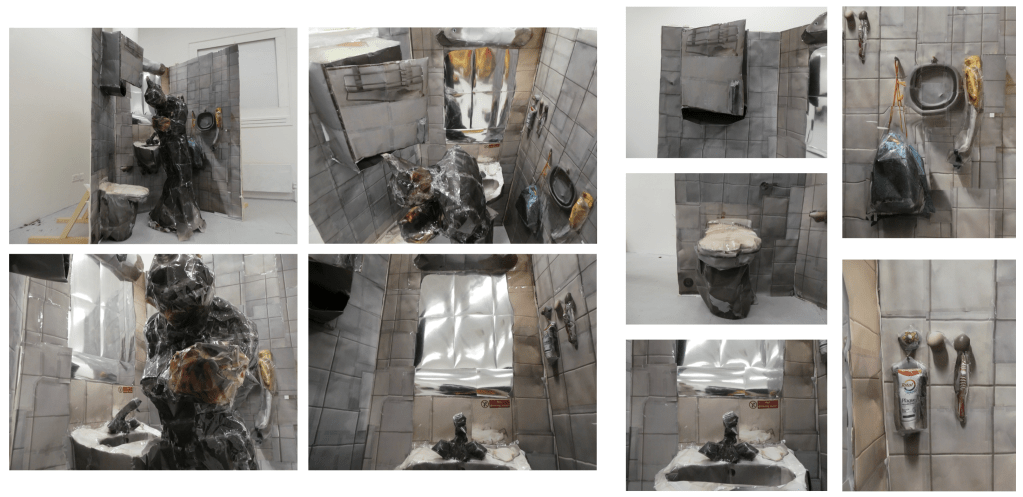
    The piece questions whether it is truly reasonable to rely on the images and information that surround us—through newspapers, TV, the internet, social media, and more—as the standard of truth. If the images and information that shape our era were manipulated and not truthful, would we even consider it a problem? Perhaps we already know this but remain complacent, merely accepting what is given to us. It is necessary to ask where the deep-seated beliefs we take for granted originate from.  

    The process of transforming real objects and places into 2D through 3D scanning, and then back into 3D sculptures, mirrors the media-driven nature of our contemporary society. Cutting, pasting, using different parts, erasing what exists, and creating what does not—the purpose of representing real eventually fades, leaving only the goal of making something appear natural. Rather than striving to present things as they are, the process becomes about crafting images that align with what people already know and believe to be true. Through this, we can observe the fabricated images and information that permeate our politics, society, and everyday lives.  

    Even though these images are distorted, people recognise them, find them familiar, yet simultaneously sense subtle differences and a feeling of estrangement from reality. By creating sculptures at the same scale as digitalised images, the work physically occupies space in the real world, blurring the boundary between digital and reality. This work does not belong to any specific place but instead settles in the liminal space that exists in between.

    신문, TV, 인터넷, 소셜미디아 등 많은 것을 비롯해 우리는 둘러싸고 있는 이미지들과 정보들, 우리가 눈으로 보는 것들을 진실의 기준으로 삼고 그것을 의지하며 살아가는 것이 과연 타당한 일인가에 대해 의문을 제기한다. 만일 우리시대를 이루고 있는 이미지들과 정보들이 조작되고 진실이 아니라 한들 우리가 그것을 문제로 삼을지에 대한 확신도 없다. 어쩌면 우리는 이미 알고서도 안일하게 생각하고 그저 받아들이기만 하고 있는것이 아닌지, 우리가 당연시 가지고 있는 깊은 믿음들은 어디에서 왔는지 물어볼 필요가 있다.

    실제 오브제와 장소들을 3D 스캔을 통해 2D로 바꾸고, 그것을 또 3D 스컵쳐로 바꾼 이 작업의 과정은 미디어로 이루어진 우리 현대사회와 닮아 있다.  자르고, 이어붙이고, 다른 영역의 것을 가져오기도 하며, 있는것을 없애고 없는것을 만들어내 어느 시점으로부터 실제를 replica 한다는 목적성은 사라진채 자연스럽게 만드는 목적만 남았다. 있는 그대로의 모습을 보여주기 위한 노력보다, 사람들이 알고 있는, 그렇게 믿고 보이기 위한 과정들로 통해 요즘 정치, 사회 우리를 둘러싼 모든 허구의 이미지들과 정보들을 볼 수 있다.

    왜곡 되어있는 이미지들임에도 불구하고 사람들은 무엇인지 알고 익숙함을 느끼며 그와 동시에 현실과 미묘한 차이와 이질감을 느낀다. 디지털화 된 이미지들을 실제 사이즈와 같은 크기로 sculpture를 만듦으로써 현실세계에 공간을 차지하며 디지털과 현실의 경계를 무너뜨린다. 이 작업은 어떠한 곳에 있지 않으며, 그 사이인 liminal space에 자리를 잡고 있다. 

  • A solid glitch

    2025

    The piece questions whether it is truly reasonable to rely on the images and information that surround us—through newspapers, TV, the internet, social media, and more—as the standard of truth. If the images and information that shape our era were manipulated and not truthful, would we even consider it a problem? Perhaps we already know this but remain complacent, merely accepting what is given to us. It is necessary to ask where the deep-seated beliefs we take for granted originate from.  

    2025, mixed media with A4 printings, wooden boards, coating resin. Dimensions variable

  • You belong no where

    2024

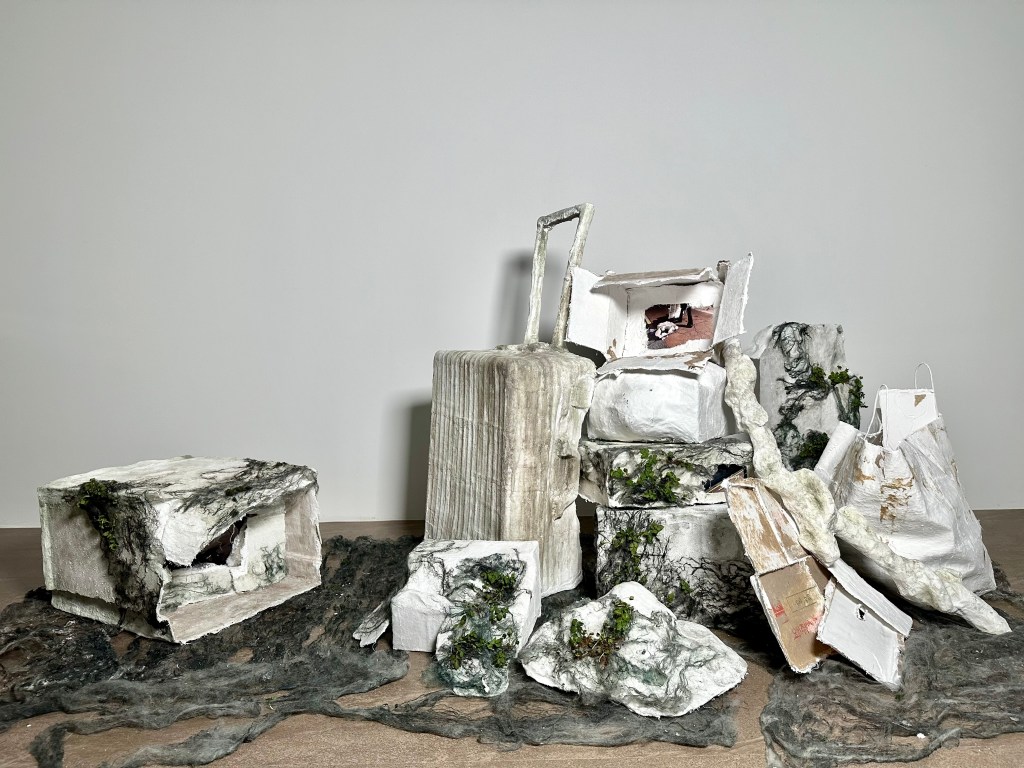
    Every time we have a change in life, we have to think about what is the most important thing that we should take with us and what we have to give up to move. It could be culture, language, family, hometown, or memory. We put a lot of effort into the things we take when we move, and they can still be damaged, missing, or given up in the end. Even though we left them, they also keep changing. For example, I could forget some part of the memory I left, or the memory could be distorted as time passes and it becomes a new identity.

    2024, Video installation; Three-channel video (looped); Mixed media with casted plaster bandage, wool felt, seeds, iphone, and ipads Dimensions variable

    Performance Video_1

    Performance Video_2

    Performance Video_3